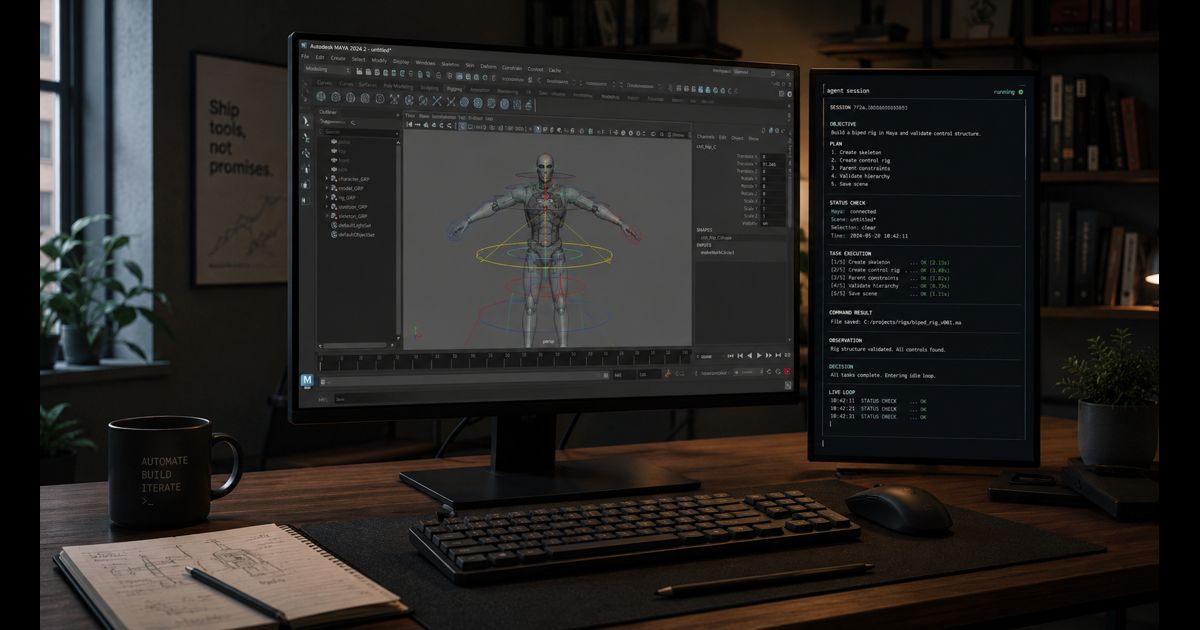
This is my current Codex workflow for Autodesk Maya in May 2026.
The short version: I do not want an agent that only edits Maya Python files. I want it to drive Maya, run the tool in the actual host application, inspect what happened, patch the code, and run it again.
That sounds obvious. It is not how most coding agents work by default.
Most agents are still very file-system shaped. They read files, edit files, run tests, and report a diff. That works great for a CLI or a web app. It is only half the loop for Maya.
Maya is the runtime. The scene is state. The UI matters. Plugin load order matters. Script editor errors matter. A tool can import fine in plain Python and still fail the moment Maya’s event loop, command engine, or scene graph gets involved.
So I built the workflow around a small bridge to a real Maya session.
Not because I want more agent infrastructure. I want less guessing.
The Problem
I do a lot of Autodesk Maya work for clients: rigging, pipeline tools, exporters, scene automation, UI work, and all the annoying little helpers that only make sense inside a DCC application.
This work has a nasty property: the source code lies.
A Python function can look correct. The unit test can pass. The package can import. Then Maya loads it in a different environment, with a different plugin state, against a real production scene, and suddenly the thing falls apart.
Examples:
- a UI works until it is reopened after a reload
- a rig helper creates nodes with the wrong namespace
- a tool assumes a plugin is loaded
- a menu command survives import but fails when triggered from Maya
- a script works on a clean scene but not on the client scene
- a callback keeps state from the previous run
This is not exotic. This is normal Maya development.
If Codex only sees the repo, it can produce plausible patches. Sometimes very good patches. But it is still guessing about the thing that actually matters: what happens in Maya.
The Setup
The core is a small tool I call gg_mayasessiond. Its job is to keep Maya reachable from Codex without turning the whole application into a free-for-all.
The idea is boring on purpose:
- keep Maya running
- expose a small set of commands
- let Codex attach to that session
- run focused checks inside Maya
- send back the useful errors
I do not want Codex to have “access to Maya” in some vague magical sense. I want it to have a few simple operations I can trust.
Start Maya. Load the tool. Run a small check. Inspect the scene. Read the errors. Report what happened.
The command surface is intentionally small: check the environment, start the session, ask for status, call a tool, read a short report, stop the session. Behind that it keeps a state folder with the current process state, recent events, and the daemon log. That sounds mundane, but it is exactly what makes the workflow usable. When something fails, Codex can point at the log instead of guessing.
Calls go through the long-running Maya session first. If that path is unhealthy, the tooling can fall back to a one-shot call. The important thing is that the result says which path was used, so I can tell whether a check really touched the live session.
That is enough.
The Loop
The loop I want is:
- Codex reads the repo instructions.
- Codex inspects the Maya tool code.
- Codex starts or attaches to the Maya session.
- Codex runs a tiny Maya-side probe.
- Codex makes a narrow code change.
- Codex reloads or reruns the tool in Maya.
- Codex reports the result with changed files, logs, and remaining uncertainty.
The important part is step 6.
Without it, the agent is doing what every junior developer does in a new Maya codebase: reading code and making educated guesses. Useful, but incomplete.
With it, Codex can close the loop:
edit -> load in Maya -> run -> inspect -> patch -> run again
That is the difference between “AI generated a patch” and “the tool actually ran in the host app”.
Why Not Just Use Tests?
Tests are great. I still want tests.
But a lot of Maya bugs are integration bugs with a very expensive runtime attached. Mocking Maya too aggressively gives you confidence in the mock. Running plain Python catches syntax and some logic. It does not tell you whether the real command behaves correctly in the real application.
The useful split is:
- plain Python tests for logic
- static checks for packaging and imports
- Maya session checks for host behavior
I want Codex to use all three.
For normal repo work it can still do the usual things:
git status --short
rg --files
pytest
For Maya work, those are setup steps. The proof is inside Maya.
MCP Is Useful Here, But Keep It Small
I am not generally excited by giant MCP servers that dump half the world into the agent context. They often feel like a tax. Lots of tokens, lots of vague affordances, not much signal.
Maya is one of the places where a narrow tool bridge actually makes sense.
Maya is huge. You do not want an agent wandering around it with unlimited freedom. You want a small surface that exposes the few things needed for a development loop:
- current session state
- known commands
- explicit inputs and outputs
- recent host errors
- scene inspection helpers
- reload hooks
- smoke checks
That can be MCP. It can also be a CLI. I do not care much about the wrapper. I care that the interface is small and easy for the agent to call.
The best tool boundary is boring. If I cannot explain the operation in one sentence, it probably does not belong in the first version.
Repo Instructions Still Matter
The Maya bridge is the fun part. The boring part is what keeps it usable.
Every serious repo needs an AGENTS.md.
That file tells Codex what the repo is, what to read, which commands are safe, how to test, what not to touch, and what counts as done. For Maya work, it also needs to say when the Maya session is part of verification.
My shared defaults live in:
~/Projects/agent-scripts
That gives repos a common base: git rules, docs conventions, helper scripts, and small workflow notes. Project repos then add their local rules.
For Maya, the useful instructions are very concrete:
- read the repo docs before editing
- keep diffs narrow
- do not reset my worktree
- do not swap package managers
- prefer repo scripts
- use the Maya session when available
- say which Maya-side command was run
- include host errors in the final report
- stop if the session state is unclear
This is not bureaucracy. This is how you stop automation from turning into an expensive randomizer.
The Current Stack
As of May 2026, Codex is the driver. Maya stays open. A small bridge lets the agent run checks in the app. AGENTS.md and a few shared scripts keep it from doing surprising things.
There are other pieces around it: notes in Obsidian, provider tracking in CodexBar, some remote-machine experiments, and the usual GitHub workflow. They matter, but they are not the story.
The story is simple:
Codex should be able to prove a Maya change in Maya.
What This Changes
The old loop is manual:
- ask for code
- copy or sync it into the Maya tool
- reload Maya or reload the package
- click around
- copy the error back into chat
- ask for another patch
That works, but it wastes the human on glue work.
The better loop is:
- Codex reads the repo
- Codex runs the Maya-side check
- Codex patches the code
- Codex reruns the check
- I review the diff and the evidence
Now I can delegate different tasks:
- reproduce a tool failure
- test a menu command
- inspect generated nodes
- validate a rig helper
- run a scene migration smoke check
- capture the exact host error
- verify that a reload actually fixed the issue
That last point matters. A lot of Maya bugs are reload bugs. If the agent cannot reload the tool in Maya, it cannot really verify them.
Sharp Edges
This needs discipline.
Maya scenes can contain client work. Tools can mutate files, shelves, preferences, scenes, and caches. An agent should not get broad write access just because it can run a command.
The bridge needs clear boundaries:
- which session is active
- which scene is loaded
- which commands are allowed
- what can be mutated
- what should be read-only
- what counts as a passing check
I also do not want client-specific details leaking into logs, blog posts, or public issues. That means verification reports need to be useful without being chatty.
The agent should say:
- command run
- result
- relevant error
- files changed
- confidence
- what it did not verify
Not a victory lap.
Why I Like This Direction
The point is not “AI for Maya”.
The point is that serious software development often happens inside environments that are not nice little test runners. Maya, Unity, Unreal, Houdini, Blender, CAD tools, internal pipeline apps, weird vendor SDKs. The code is only part of the system.
Agents get much more useful when they can touch the real runtime through a narrow, repeatable, auditable interface.
That is what the Maya bridge gives me.
It turns Codex from a code patcher into something closer to a developer sitting next to the host app. Still supervised. Still constrained. But finally looking at the thing I care about.
Next
The next step is making the Maya loop boring enough that I trust it every day.
I want a few repeatable recipes:
- start a clean Maya session
- attach to an existing session
- load the tool
- run a small check
- reload after a patch
- capture the errors
Once that is solid, the workflow becomes obvious:
Give Codex the repo, the rules, and the smallest possible bridge into Maya. Let it work. Review the evidence.
No mysticism. Just a tighter loop.